
BARNEWS
How did the idea for Vibes Riviera come about?
Manon: Yoann and I had been living in London for the past six years, and Vibes was a project we had been thinking about for quite some time. The idea came from talking about things we both loved—music, cocktails, and so on. We could picture ourselves opening our bar in Nice, particularly because of our love for the heritage of the French Riviera and its particular dolce vita. And, to be fair, we were starting to miss the sun and the sea in London (laughs).
Yoann: Even though London was an amazing experience for both of us, the prospect of opening Vibes in Nice and bringing this cocktail culture of classics and Modern Classics to the south of France—where it is beginning to grow—was really exciting. The idea gradually took shape until we reached the point where we said: this is where we want to do it! I’m originally from Beausoleil, nearby, and Manon has considered this region her adopted home for several years now. So sharing this heritage made perfect sense to us.
The French Riviera is very well known abroad, and whenever I explained that I came from the Côte d’Azur, people would often react by saying, “You must be rich!” But that didn’t reflect my own background. Of course, glamour, the Cannes Film Festival, and Monaco are part of the French Riviera and its mythology, but there is much more to it than that. There is a genuine culture that we want to showcase through our bar—in the interior design, the choice of materials, but also in the style of our drinks.
Music also plays a central role. When we were still in London, music helped us imagine and visualise Vibes. Our other partner, Bryan Gaillard, is incredibly knowledgeable and passionate about music. He has set up a very specific sound system—with vintage tube amplifiers and a particular type of speaker—designed for the genres we favour, mainly funk, boogie, disco and Afrobeat.
This musical identity is an integral part of the Vibes experience because, above all, we want our guests to have a good time. That is why we pay so much attention to the welcome, the service and hospitality.
The project goes beyond being just a cocktail bar.
Vibes Riviera – 📷 Simona Simonetti
What is the venue’s capacity?
Manon: Vibes has around fifteen seats on the terrace. Inside, we can accommodate between 35 and 40 seated guests. There are also four seats at the bar—it’s a small counter.
The neighbourhood where we are located has a small village feel, with lots of locals. It’s fairly young, but there’s also a mix of generations who seem curious about new things. A distillery—La Vadrouilleuse—is opening right next door, and Famille Ricci isn’t far away. Place du Pin is only a minute away. The area is pedestrianised, with lots of restaurants, as well as cocktail bars such as Povera, by Maxime Potfer, and SuperBar. That atmosphere is exactly why we wanted to open here.
We like to use the term “cocktail bistro”, because in France the word bistro strongly evokes values such as conviviality, accessibility and comfort. So “cocktail bistro” fits the identity of Vibes Riviera perfectly: a place where people feel good, and which isn’t simply a bar located in a neighbourhood, but a true neighbourhood bar.
How is the cocktail offering structured?
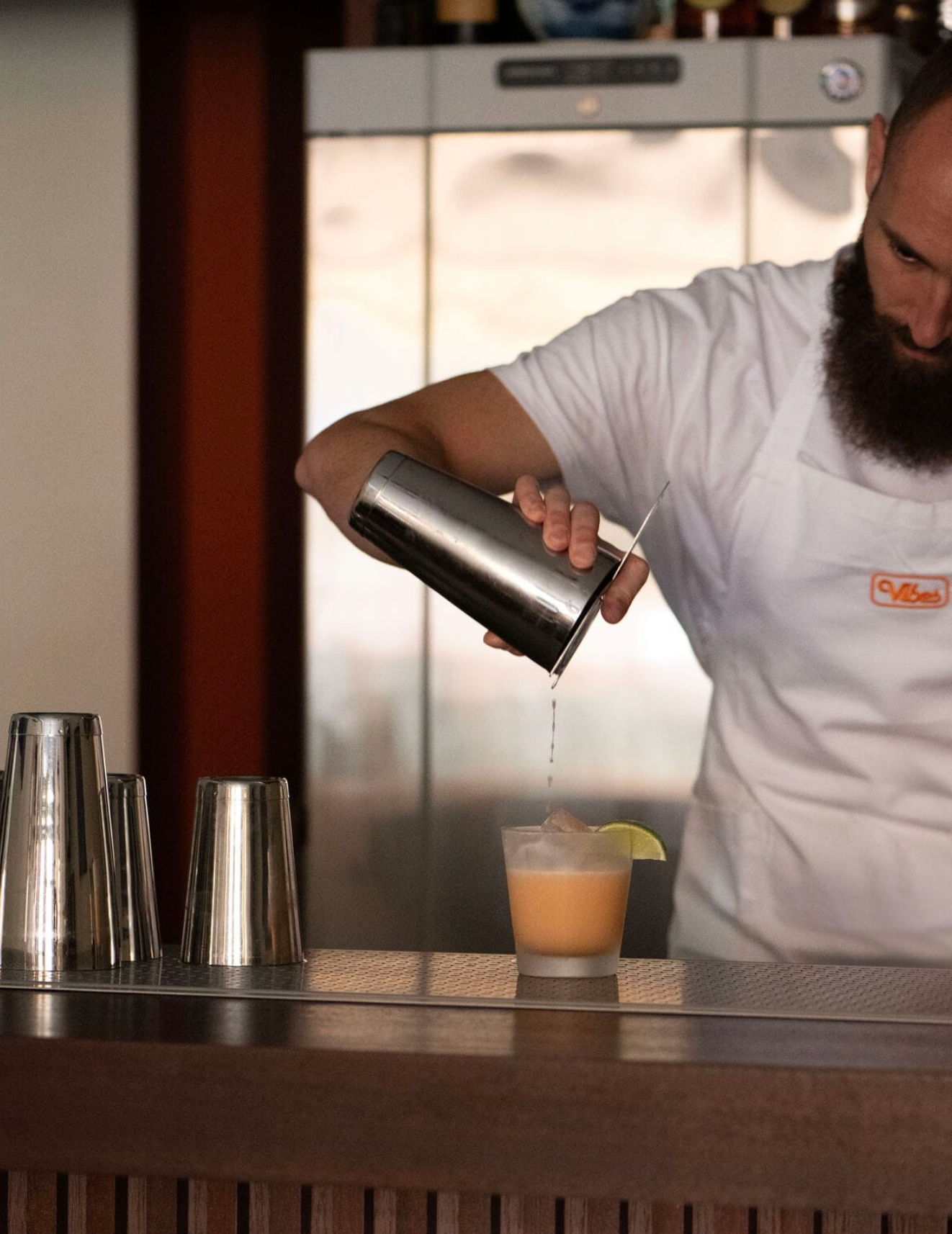
Manon: It is mainly centred around classics and Modern Classics, with seasonal influences whenever possible. Typically, during summer, in July, when peaches are exceptional, we serve a frozen peach Daiquiri. So when certain products are available, we’re delighted to use them because we’re lucky enough to have access to an incredible local terroir.
Yoann: A Bellini made with seasonal peaches, for example. Everyone knows that cocktail, but not necessarily with fruit from the French Riviera. That’s what will make our Bellini special.
So there won’t be a Bellini or a Strawberry Margarita in December. However, we don’t restrict ourselves to extreme seasonality across the entire drinks menu. Vibes is a classic cocktail bar, and we use lemon and lime all year round. For our Margarita, we need that lime flavour and the texture provided by the fruit’s pectin—something an “acid blend” cannot replace.
That’s why seasonality isn’t something we particularly promote. We respect it when it serves the cocktail. It’s a natural and logical approach—in the same way that a good restaurant wouldn’t serve tomatoes out of season. It goes without saying.
Peach Daiquiri – Vibes Riviera – 📷 Simona Simonetti
Vibes’ DNA is based on drinks that are easy to understand, comforting and accessible. Our establishment is located within an emerging cocktail scene, and we want guests to be able to understand and enjoy the menu easily. Delicious simplicity, in a way, with a focus on our local terroir whenever it makes sense.
This accessibility is important when it comes to cocktails. Some bars focus on modern techniques and unusual flavour combinations. That’s fantastic, but it’s not what we do.
We like Modern Classics because they offer the possibility of creating something here—our own signatures—which, just like the Penicillin, Paper Plane or Naked & Famous, could potentially be recreated all around the world because their ingredients are accessible.
Manon: Another particular feature of ours is that we change the menu every day.
You change the menu every day?
Manon: Yes!
The menu features around ten cocktails that change every day. To make this possible, we have a sort of bible of classic cocktails that we continuously work from—because we also create our own drinks—but always while maintaining that framework of classics that can be reproduced anywhere in the world.
Yoann: The reason the menu changes like this is simply to give guests some direction. It’s a little like a Bartender’s Choice. The bartender creates their own menu that day depending on the ingredients available, but also according to their own preferences, the day of the week and the type of customers expected.
Will it mainly be industry people who already know a lot about cocktails? Or mostly tourists? For example, we can allow ourselves to feature more obscure drinks on a Sunday evening. And guests are still free to order off-menu.
Does the menu follow a particular structure?
Yoann: Exactly. The menu is structured around a certain balance: bitterness, spirit-forward drinks, Low ABV, long refreshing drinks, sour, fruity and sweet cocktails, but also according to the type of base spirit.
That is why our daily offering is fairly extensive—close to fifteen drinks—so that we can offer a variety of different cocktail styles and flavours. That balance is a key element when putting together the menu at Vibes.
Manon: We also pay a lot of attention to non-alcoholic cocktails. We also have bottled beers and wines to round out the offering.
Vibes Riviera (Nice) – Example of a daily menu
Do you showcase ingredients from the south of France? I noticed that you offer your own version of the Mauresque.
Manon: We place a lot of importance on French products in general—not only spirits from the south of France.
After coming back from London, we were struck by just how many there are: eaux-de-vie, aperitifs, bitters, vermouths… The choice seems endless. So yes, definitely!
It doesn’t work for all our creations because we like to remain rooted in classics, but the Maurescolada is a good example. We love the Mauresque, as well as the Piña Colada, and we also love pastis. So naturally, we created a cocktail combining the two, because pastis is part of the culture here—and arguably throughout France.
Giving importance to our French heritage and introducing people to new things is something we genuinely care about.
Maurescolada – Vibes Riviera – 📷 Simona Simonetti
Yoann: It opens up a huge number of possibilities because these are ingredients that you ultimately don’t have access to in the same way outside France.
The Italian amaro category has become incredibly successful over the past ten years. It has become an ingredient found in almost every cocktail bar—particularly in the United States, where having an amaro drink on the menu has become almost compulsory.
That’s a good thing, but we want to show that French heritage is also of exceptional quality, with products such as Dubonnet, Suze and Cap Mattei, to name some of the best-known examples.
On that subject, we met Karim Karroum from La Distillerie de Grandmont. And products such as Menthe Glaciale, gentian, or Chemin des Moines—which is somewhat similar to Chartreuse—are incredible.
Having the opportunity to work with products like these, combined with our knowledge of classic cocktails, is one of the reasons why we specifically wanted to come here.
We were also lucky enough to run a four-month Vibes pop-up residency last summer at a friend’s restaurant on Larvotto Beach in Monaco.
The Maurescolada was incredibly successful, as was the Vibes Spritz. In fact, it was the only cocktail that remained on the menu throughout the entire season—which was a good indication of just how accessible the drinks we create can be.
It showcased St-Germain, Suze, a touch of passion fruit and absinthe, topped with prosecco and soda water. So there was this element of French heritage—slightly more contemporary with St-Germain, which is very well known and approachable—combined with the clever little touch of bitterness from Suze, while the absinthe added depth and enhanced the floral character of St-Germain.
That cocktail worked extremely well. It uses Suze in quite an unusual way. It’s a great example of what we were talking about earlier.
As a fun fact, our Vibes Spritz often appears on the menu at Satan’s Whiskers in London!
Vibes Spritz – Vibes Riviera – 📷 Simona Simonetti
So, despite having only just opened, you already have one or two signature cocktails. Will they remain permanently on the menu?
Manon: The Maurescolada will always be available because it’s made entirely from ingredients we always have behind the bar: coconut sorbet, coconut cream, fresh pineapple both in pieces and as juice, amaretto, pastis and coconut rum.
So we can make it at any time, and it will certainly appear on the menu fairly regularly because we really like it!
It’s very popular overall and works as a great alternative to a Piña Colada. It also incorporates elements rooted in the south of France, which we are quite proud of.
All of our signature cocktails are made using ingredients available every day, throughout the year.
Do you use modern techniques such as a rotavap?
Manon: No. Everything is fresh, and fruit juices are made the same day.
We’ve had the opportunity to experience bars using these techniques in London, New York and elsewhere around the world. They do it extremely well, but it simply doesn’t match our style.
Yoann: Our bar has a different identity. It is based on very traditional bartending techniques, with the ability to make a cocktail to order and ensure that guests receive it precisely when it is at its best.
Behind the bar, we have two large upright freezers—one for each station—to control the temperature of the drink, dilution, and everything connected to the tasting experience.
It may sound simple, but our “bar program” is very carefully structured, with a huge amount of preparation beforehand. Everything, however, is designed to make the overall experience accessible.
We focus on the things that every bar should be doing—even though that is far from always being the case.
We often quote Sasha Petraske, founder of Milk & Honey in New York. To illustrate the importance of texture and temperature in a cocktail, he used the example of Coca-Cola: you open an ice-cold bottle in the middle of summer, it’s beautifully fizzy and incredibly refreshing. But if the same Coca-Cola is warm and has been open for three days, it’s a completely different experience. And yet the recipe is exactly the same.
In that respect, Satan’s Whiskers inspired us greatly through the level of care they put into every stage of the process.
As for the rotavap, as Manon was saying, we have the La Vadrouilleuse distillery next door, Famille Ricci also has stills, and we can work with La Distillerie de Grandmont. They already have all the necessary expertise.
What we do, on the other hand, is “analog bartending”.
Yoann Tarditi – Vibes Riviera – 📷 Simona Simonetti
Let’s talk about your respective backgrounds. How did each of you get into the bar industry?
Manon: I studied hospitality and tourism management at Vatel in Paris. After graduating, I went abroad to travel and improve my English.
I could see myself working in hospitality, but not in Paris, because it had a very traditional, luxury palace-style culture that didn’t entirely suit me.
That’s why I moved to London, where I started working in Events at The London Edition. From there, my interest in bars kept growing—particularly because of the interaction with guests.
I became a waitress at the lobby bar at Edition, where I met Yoann, who was working there as Head Bartender.
Afterwards, I wanted to discover another side of the profession by moving behind the bar, and Pierre-Marie Bisson gave me my first opportunity as a Junior Bartender at Milk & Honey, where he was Bar Manager at the time.
Unfortunately, that was perhaps only two or three weeks before the COVID lockdown and the venue’s permanent closure.
I continued my career as a Barback when the NoMad opened. That was where I truly opened myself up to the world of cocktails.
At the NoMad, there are many stages of service and a lot of rules to follow. It’s very specific and highly standardised, and I immediately connected with that mindset.
Over three years, I progressed from Bartender to Head Bartender and then Assistant Bar Manager.
It was an incredible experience that, among other things, taught me how to manage a team of around ten people.
Eventually, I left my position in 2024 to open Vibes Riviera.
Yoann: I started working in restaurants during school holidays when I was 16 because, on the Côte d’Azur, there is a huge demand for seasonal staff.
I come from a family where making people happy and creating a sense of conviviality are very important. That undoubtedly influenced me without me really realising it, and I immediately felt comfortable in the world of hospitality and service.
My beginnings behind the bar happened completely by accident. While working in a restaurant, I dropped an entire bread basket in front of the chef, and as punishment he banished me to the bar.
I liked the position, so I stayed there for the rest of the season.
After finishing secondary school, a friend encouraged me to join him in London to learn English. My previous experience meant I was able to get hired behind the bar at a steakhouse, even though I barely spoke the language.
Then, with the same group of friends, we went to Australia, where I found a job as a bartender in a very busy restaurant.
It was my first job where I was making cocktails and really interacting with customers. I enjoyed it even more, especially because I discovered Sydney’s incredible bar scene at the time, and that’s when I realised this was what I wanted to do.
Six months later—because of the conditions of the working holiday visa—I had to change jobs, so I moved to Melbourne.
It turned out to be the best possible decision because I worked with some of the most talented bartenders in the city.
I had originally thought I would stay in Australia for just one year, but in the end I lived there for five years.
Cocktail bars became my life, and I threw myself completely into the industry, eventually becoming a manager for the opening of a new venue.
Eventually, however, I decided to return to Europe because the distance was starting to become difficult.
Back in London, with the experience I had gained, a real bartending career opened up for me.
I very quickly found a job at an exceptional venue: The London Edition, which had an amazing bar program and where I met Manon.
It was my first experience working in a hotel bar, and it taught me the art of hospitality, the importance of welcoming guests and the overall “guest experience”.
When Edition reopened after COVID, the atmosphere and dynamics changed, and I no longer really felt at home there.
That was around the time Satan’s Whiskers was hiring. It had always been my favourite bar because it represents exactly the kind of cocktails I enjoy both drinking and making. Manon and I often went there as customers.
Clover Club – Vibes Riviera – 📷 Simona Simonetti
How was your experience at Satan’s Whiskers?
Yoann: When I met Emilio di Salvo, who was Bar Manager at Satan’s, we immediately got along.
I wanted to reconnect with my original love for neighbourhood cocktail bars, while gaining a complete understanding of how that type of establishment operates, because our goal was ultimately to open our own bar in the medium term.
So I was lucky enough to work in my dream bar for almost three years, with an exceptional team and incredible owners, Kevin Armstrong and Daniel Waddy.
Satan’s Whiskers is by far the hardest place I have ever worked. But it is by stepping outside your comfort zone that you discover abilities you never knew you had.
You have to understand that the menu changes every day. It’s personalised table service, but with an incredible volume of customers.
People from across the global bar industry come to watch how you work.
As a result, the pressure is constant, and you often feel like you’re the least talented person in the room, while at the same time being inspired by your colleagues.
Yoann Tarditi – Vibes Riviera – 📷 Simona Simonetti
In an interview with Barnews, Andy Loudon, Director of Scarfes Bar in London, explained that he had learned more from 20 minutes of conversation with Kevin Armstrong than from several years of experience…
Yoann: I completely agree with Andy Loudon on that point.
Kevin Armstrong is at the bar every day before service, and the team spends two or three hours with him discussing things and sharing our different perspectives.
Kevin isn’t simply someone who talks. He’s also someone who listens—and, in my opinion, that is one of the keys to intelligence. That’s why the conversations are so fascinating.
And I would also give just as much credit to Daniel Waddy, Kevin Armstrong’s right-hand man.
He now owns shares in the bar and co-wrote their book, Roundbuilding. Dan is the ultimate bar geek.
He has tried absolutely everything, and he tests everything in a very methodical way.
He is constantly asking himself: why? What happens if I shake for 45 seconds instead of 20? Or instead of 15? What happens with three or four ice cubes?
He then puts the different samples into test tubes to study their texture and temperature.
He is constantly involved in service, just like any other member of the team—a working bartender.
Then, once the bar had closed, at around 2:30 a.m., we would finish with speed & accuracy tests at 2.5, 5 and 10 in free pour, followed by a debrief of the evening.
It’s a constant process of questioning yourself, with endless conversations that could go on until five in the morning, all with one simple objective: to serve the best possible cocktail at the exact moment it touches the guest’s lips.
That’s it. But it is the foundation of our profession.
That habit of questioning everything on a daily basis inspired us enormously when we were thinking about our own bar.
It is a shared legacy that Manon and I are bringing here, and which will now develop differently from what we experienced before, influenced by this new environment.
Vibes Riviera is the sum of all our experiences. There is as much NoMad as there is Satan’s Whiskers: the culture of personalised hospitality found in an exceptional hotel such as the NoMad, a shared cocktail DNA built around the classics, and, of course, Satan’s Whiskers, with its daily menu changes and its identity as the ultimate neighbourhood bar with an international reputation.
Being surrounded by people who were so deeply committed to their work was a real joy.
I also think of Kevin Rigault—Director of Les Ambassadeurs, the bar at Hôtel de Crillon (editor’s note)—with whom we worked at the London Edition, and who shares the same level of demanding standards.
Kevin is the only person who ever arrived—two days after we hired him—with his own set of jiggers, having checked beforehand that all their measurements were accurate.
We did the same thing ourselves at the bar, and that reflected a similar attention to detail.
We had countless conversations about this during that period.
That’s why we’ve met up regularly ever since, including at the first Vibes pop-up event.
In fact, that evening, he ended up working as our barback and washing glasses because we were completely overwhelmed! (laughs).