
Article: LE FIGARO
LE FIGARO
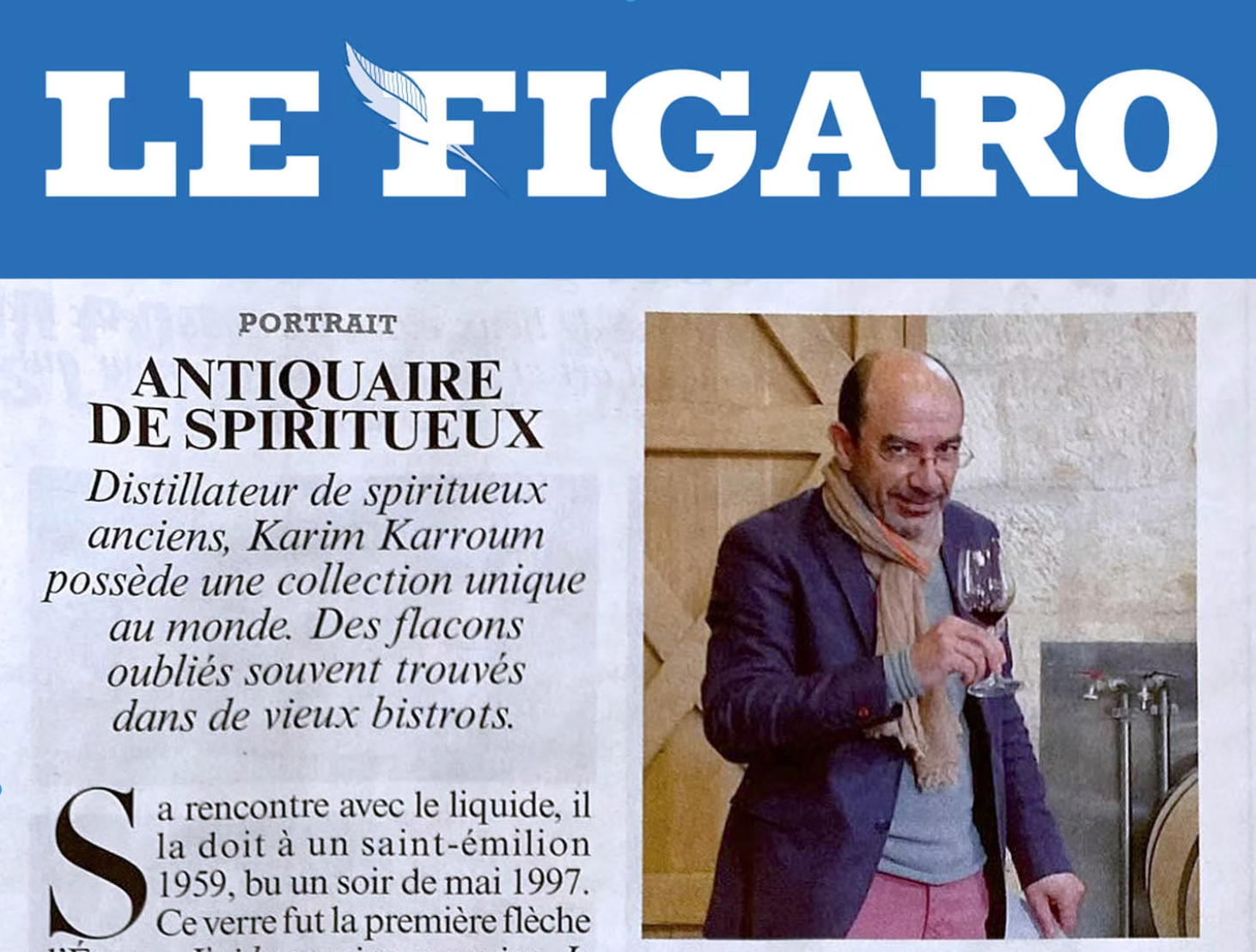
If he spends his life in old bistros, it is to seek out forgotten bottles from the last century. A new distiller of historic spirits, Karim Karroum is at the head of a collection unlike any other in the world.
His first encounter with the world of fine drinks came thanks to a 1959 Saint-Émilion, tasted one evening in May 1997. That glass was Cupid’s first arrow. “I’m passionate by nature. I started getting into old Bordeaux vintages.” The second arrow struck when he discovered the world of spirits.
Karim Karroum then created Les Petits Celliers, an online wine and spirits shop offering bottles dating from the 19th century through to the 1970s. Within a few years, he became both a collector and treasure hunter, two roles brought together under the poetic title of “spirits antiquarian”.
Guided by a network of scouts whose number he prefers not to reveal, he travels across France exploring the cellars of long-forgotten bistros and assessing collections inherited by people unsure what to do with their ancestors’ old bottles of Chartreuse.
“We have entered a more health-conscious era. Many people no longer drink alcohol and are getting rid of their bottles.”
This decline in interest is the result of a profound change in habits. He nostalgically recalls a time when every meal naturally involved an aperitif, a white wine, a red wine and a digestif.
“We have lost something in France. Even 20 years ago, people were less cautious about it.”
And yet the tide seems to be turning. A younger generation is rediscovering old spirits forgotten at the back of cupboards, alongside a desire to drink less but better, and a growing interest in mixology.
Gone are the days of the overly sweet Piña Colada topped with a little paper umbrella; today, the focus is on bespoke cocktails and a market where prices are soaring.
“Unlike wine, where we know every year how many bottles are released, the old spirits market has no established price guide because there is no continuity of production.”
Last January, he sold a Polish buyer what is believed to be the oldest known Cognac in the world: a Clos de Greffier 1738.
Working from an old recipe book dating from the end of the 19th century, he has now set himself the task of bringing back to life “the great stars of French aperitif and digestif culture” by creating the Distillerie de Grandmont, in the heart of the Limousin region.
First came a gentian liqueur, followed by a white Curaçao triple sec, which he now exports around the world.
“Everything is organic, wild and natural.”
Eventually, the range will include around ten spirits.
But nothing will stop him from preserving his almost mystical passion for century-old bottles.
“If God exists, he will have drunk Chartreuse,” he murmurs.
Yes—but probably not only Chartreuse.